
Announcement
President’s Message
July 19, 2026
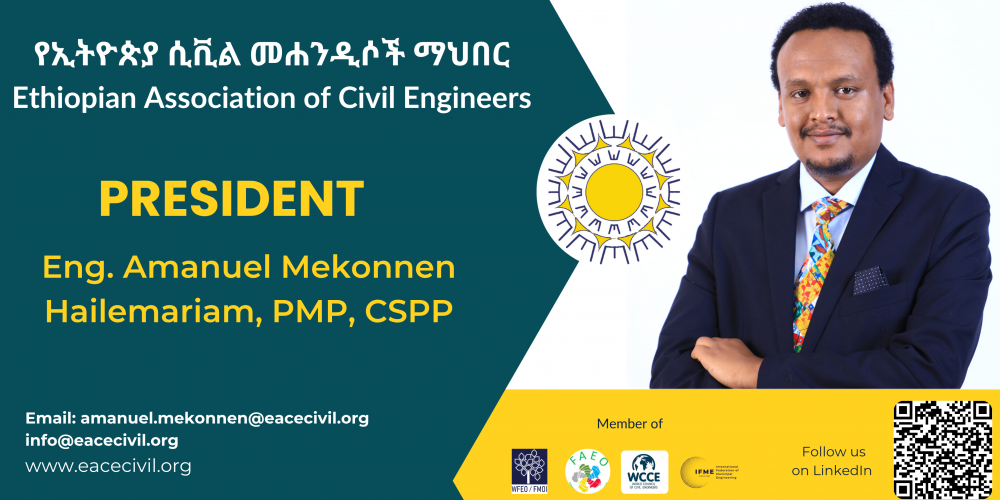
Eng. Amanuel Mekonnen Hailemariam, PMP, P.E.
President, Ethiopian Association of Civil Engineers (EACE)
Dear Members, Partners, Colleagues, and Friends,
It is with great honor and a deep sense of responsibility that I address you as President of the Ethiopian Association of Civil Engineers (EACE). Our Association stands as a professional institution committed to advancing engineering excellence, promoting sustainable infrastructure, strengthening professional competence, and contributing to national, regional, and global development.
In an era characterized by rapid urbanization, climate change, technological transformation, population growth, and increasing infrastructure demands, the role of engineers has never been more important. Civil engineers are not merely designers and builders of infrastructure; we are innovators, problem-solvers, leaders, and stewards of sustainable development.
As Ethiopia and Africa continue their journey toward economic growth and social transformation, engineers must play a central role in shaping resilient communities, sustainable cities, efficient transportation systems, water security, clean energy infrastructure, and climate-adaptive development. The future we envision depends on our collective ability to engineer solutions that are technically sound, socially inclusive, economically viable, and environmentally responsible.
Engineering for Sustainable Development
Sustainable development remains at the heart of EACE's vision and strategic direction. The United Nations Sustainable Development Goals (SDGs) provide a clear framework for the challenges and opportunities facing humanity today. Engineers are indispensable contributors to achieving these goals, particularly those related to clean water and sanitation, affordable and clean energy, industry and innovation, resilient infrastructure, sustainable cities and communities, climate action, and partnerships for development.
EACE is committed to promoting engineering practices that contribute to the achievement of the SDGs by encouraging sustainable infrastructure development, climate resilience, environmental stewardship, resource efficiency, and social responsibility. We believe that every infrastructure project should create long-term value for communities while protecting the environment for future generations.
Renewable Energy and Climate Resilience
The transition toward a green and low-carbon economy presents unprecedented opportunities for engineers. Ethiopia and Africa are blessed with abundant renewable energy resources, including hydropower, solar, wind, and geothermal energy.
EACE encourages engineers to actively contribute to the planning, design, implementation, and management of renewable energy projects that support energy security, economic development, and climate resilience. We will continue to advocate for sustainable energy solutions, green infrastructure, and innovative technologies that help reduce environmental impacts while enhancing quality of life.
As climate change increasingly affects our infrastructure systems, engineers must lead efforts to build resilient infrastructure capable of withstanding future environmental challenges. Sustainability and resilience must become fundamental principles of engineering practice.
Excellence in Project Management
The success of infrastructure projects is determined not only by sound engineering design but also by effective project management. Infrastructure projects today are becoming increasingly complex, requiring multidisciplinary coordination, stakeholder engagement, risk management, contract administration, financial oversight, and strategic leadership.
Recognizing this reality, EACE places strong emphasis on strengthening project management capacity within the engineering profession. We believe that improved project management competencies will significantly enhance project performance, reduce delays and cost overruns, improve quality, and maximize value for society.
To achieve this objective, EACE will continue to strengthen its strategic collaboration with the Project Management Institute (PMI), the world's leading authority in project management, and the PMI Ethiopia Chapter. Through joint training programs, conferences, professional development initiatives, certification awareness campaigns, research activities, mentorship programs, and knowledge-sharing platforms, we aim to equip engineers with globally recognized project management skills and best practices.
By integrating engineering expertise with world-class project management methodologies, we can enhance the successful delivery of infrastructure projects and contribute to improved development outcomes across Ethiopia and beyond.
Alternative Dispute Resolution and Construction Arbitration
As the construction industry expands, disputes related to contracts, variations, delays, claims, payments, and performance have become increasingly common. Such disputes often lead to project delays, increased costs, damaged professional relationships, and reduced investor confidence.
EACE recognizes the importance of Alternative Dispute Resolution (ADR), including mediation, adjudication, dispute boards, and arbitration, as effective mechanisms for resolving construction disputes efficiently and professionally.
Our collaboration with the Ethiopian Mediation and Arbitration Center (EMAC) represents an important step toward strengthening awareness, capacity, and institutional frameworks for dispute prevention and resolution within the construction sector. Through training, professional dialogue, research, and advocacy, we seek to promote a culture of dispute avoidance, sound contract management, and professional accountability.
Engineers of the future must be equipped not only with technical knowledge but also with competencies in construction law, contract management, claims administration, and arbitration procedures.
Professional Development and Lifelong Learning
The engineering profession is evolving at an unprecedented pace. Emerging technologies, digital transformation, artificial intelligence, Building Information Modeling (BIM), data analytics, sustainability requirements, and modern project delivery methods are continuously reshaping our profession.
To remain relevant and competitive, engineers must embrace lifelong learning.
EACE remains committed to providing high-quality professional development opportunities through training programs, continuing professional development (CPD), technical seminars, webinars, workshops, conferences, publications, mentorship programs, and industry engagement.
We will continue strengthening collaboration with universities, research institutions, government agencies, development partners, and industry stakeholders to ensure that engineers have access to the knowledge and skills required for the future.
Harmonization of Engineering Practice and Professional Registration
As Africa moves toward greater economic integration and increased professional mobility, harmonization of engineering education, competency standards, professional practice, certification, and registration frameworks becomes increasingly important.
EACE supports initiatives that promote mutual recognition of engineering qualifications, standardization of professional competency requirements, and harmonized registration systems across jurisdictions.
Such harmonization will strengthen professional mobility, improve quality assurance, facilitate knowledge transfer, and enhance public confidence in the engineering profession.
We will continue working with national, regional, and international partners to support frameworks that elevate professional standards and strengthen engineering excellence across Africa and beyond.
Standards, Advocacy, and Public Policy Leadership
Professional associations have an important responsibility to contribute to national development through evidence-based policy engagement, technical advisory services, and advocacy.
EACE will continue to serve as a trusted voice on matters relating to engineering policy, infrastructure development, building regulations, construction standards, public safety, environmental sustainability, and professional ethics.
We remain committed to engaging constructively with government institutions, regulatory authorities, academia, development partners, and the private sector to promote sound engineering policies and strengthen the country's infrastructure ecosystem.
As advocates for engineering excellence, we will continue contributing to the development and improvement of standards, regulations, and institutional frameworks that support sustainable national development.
International Engagement and Global Leadership
Engineering is a global profession, and many of the challenges we face today require international cooperation, knowledge exchange, and collective action.
EACE is proud to be an active member of five international engineering federations and organizations:
- World Federation of Engineering Organizations (WFEO)
- Federation of African Engineering Organisations (FAEO) – Founding Member
- International Federation of Municipal Engineering (IFME)
- World Council of Civil Engineers (WCCE)
- Federation of Engineering Institutions of the BRICS Countries (FEIBRICS) – Founding Member
Through these memberships, EACE contributes to international dialogue on engineering education, sustainable development, climate resilience, innovation, digital transformation, infrastructure development, and professional mobility.
These global platforms enable Ethiopian engineers to participate in international initiatives, exchange knowledge and best practices, contribute African perspectives to global discussions, and strengthen the international visibility and recognition of our profession.
EACE remains committed to expanding its international engagement and ensuring that Ethiopian engineers actively contribute to solving global challenges while benefiting from global opportunities.
Strategic Partnerships and Collaboration
Strong institutions are built through strong partnerships.
EACE will continue to strengthen collaboration with leading national and international organizations that share our commitment to professional excellence, sustainable development, and engineering advancement.
In particular, we will continue our cooperation and partnership initiatives with the American Society of Civil Engineers (ASCE) and the United Nations Office for Project Services (UNOPS) -ETHIOPIA, while exploring additional collaboration opportunities with professional institutions, academic organizations, industry leaders, development agencies, and research institutions worldwide.
These partnerships create valuable opportunities for technical exchange, capacity building, research collaboration, innovation, policy dialogue, and professional development that directly benefit our members and the broader engineering community.
Sustainable Construction Materials and Innovation
The future of infrastructure requires innovative approaches to material selection, design, and construction practices.
EACE strongly supports research, development, and adoption of sustainable construction materials that reduce environmental footprints while improving durability, resilience, and lifecycle performance.
We encourage engineers, researchers, academic institutions, and industry stakeholders to promote the use of low-carbon construction materials, recycled resources, locally available materials, green building technologies, and circular economy principles.
Innovation in materials and construction methods will play a critical role in reducing greenhouse gas emissions and achieving sustainable development objectives.
Looking Ahead
The future presents significant challenges, but it also presents extraordinary opportunities.
As engineers, we have the technical knowledge, creativity, and responsibility to help shape a more sustainable, inclusive, resilient, and prosperous future.
I call upon every member of EACE to actively engage in advancing our profession, strengthening our institutions, supporting innovation, upholding the highest ethical standards, and contributing to national and global development.
Together, let us champion sustainable development, strengthen project management excellence, advance renewable energy solutions, promote effective construction dispute resolution, harmonize engineering standards, enhance professional competence, drive innovation, and elevate the standing of Ethiopian engineering on the global stage.
Let us engineer sustainable solutions. Let us build resilient communities. Let us shape the future together.
Eng. Amanuel Mekonnen Hailemariam, PMP, P.E.
President
Ethiopian Association of Civil Engineers (EACE)
"Engineering Sustainable Development through Excellence, Innovation, Leadership, and Collaboration."
Email: amanuel.mekonnen@eacecivil.org
info@eacecivil.org